Beat Survival Review:
Zombies, Aliens and a Surprisingly Charming Apocalypse
Beat Survival Review: Zombies, Aliens and a Surprisingly Charming Apocalypse
Beat Survival is a strange little game. It’s rough around the edges, occasionally confusing, surprisingly ambitious and, despite all of that, I’ve found myself liking it rather more than I expected.
Before getting into the game itself, there is one thing worth clearing up. I came across a particularly negative review that absolutely annihilated Beat Survival for its graphics, compared it with GTA and more or less asked why it wasn’t some enormous, shiny 3D production.
My immediate reaction was: Mate. You may possibly be playing the wrong bloody game.
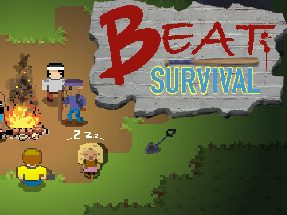
Beat Survival is not trying to be GTA. It’s an indie open-world survival game built in GameMaker Studio, with a deliberately cartoon-style presentation, survival mechanics, crafting, exploration, dark humour and, naturally, both zombies and aliens.
Lovely. Because apparently being hungry, thirsty, cold, injured and chased by the undead wasn’t enough. Someone looked at that situation and thought, “Needs extra-terrestrials.”
Perfectly reasonable.
Personally, I like how Beat Survival looks. There’s a sort of raw beauty to it. It isn’t polished within an inch of its life, and it doesn’t look like somebody has spent £80 million making sure every puddle accurately reflects the emotional state of the protagonist.
But it has character.
Maybe I’m showing my age here — I’m in my forties — but visually and mechanically it reminds me of several games I already have a soft spot for. There’s a little bit of How to Survive in its survival DNA, a touch of Prison Architect in the visual presentation and, every now and then, something about looking down on a collection of tiny people while everything slowly goes horribly wrong gives me a hint of RimWorld.
Beat Survival isn’t the same as any of those games. But if you put How to Survive, Prison Architect and RimWorld in a room together, released zombies, then aliens, and locked the doors, you might eventually get something vaguely resembling Beat Survival.
I mean that as a compliment.
There’s something about its slightly older-school approach to survival that works for me. You scavenge buildings, search for supplies and slowly work out what everything does. Occasionally you find yourself staring at an object thinking, “Can I use this? No. Can I hit something with it? Possibly. Excellent.”
That process of slowly understanding the world is part of the appeal.
My first experience with the game, though, was slightly less straightforward. Beat Survival supports two-player local co-op, and the menus initially gave me the impression that I was going to need another person before I could properly start.
Which seemed unreasonable. Finding somebody willing to survive an alien-zombie apocalypse with me should not be the first boss fight.
On my second attempt I slowed down, went through the menus properly and got into solo play. So yes, you absolutely can play Beat Survival alone, but I do think the menus could make that clearer.
Once I was actually in the game, things started clicking.
The sound works surprisingly well with the graphical style and helps give the world a decent atmosphere. I would like more variety, because after a while you begin noticing repeated sounds, but what is there generally works.
That’s something I kept coming back to while playing Beat Survival. It’s rough in places, but there’s something underneath it. Something quite charming.
There’s some useful context around the development as well. Developer Yulius Sanda contacted us directly and provided access to a private press demo.
For transparency, that access was provided free of charge. There was no payment, no requirement to produce coverage and no demand for a positive review. He specifically asked for honest feedback.
Which is exactly what he’s getting. Possibly more honestly than he anticipated.
According to Yulius, development began around 2020 during the COVID period. He initially concentrated on animation, story and game design while working with a local GML programmer. After around three months, that version ran into programming limitations.
So naturally, they started again. From scratch.
Because apparently suffering once wasn’t quite sufficient.
He later found another GML programmer through Discord and rebuilt the game, while continuing with the artwork, design and writing and beginning to learn more of the programming himself. Development later paused, funding became difficult and, by around 2025, Yulius says he had reached the point where he was effectively handling almost everything himself — including much of the programming.
Somewhere along the way this man appears to have looked at the entire development process and thought, “Fine. I’ll do that as well.”
I respect that.
It does not mean bugs get a free pass. If something doesn’t work, it doesn’t work. If a menu confuses me, I’m going to say it confused me. If something feels unfinished, I’m going to say so.
I’m reviewing the game in front of me, not awarding humanitarian aid to its source code.
But knowing the circumstances does put some of the rougher edges into perspective.
And Beat Survival is trying to simulate a surprising amount. There’s hunger, thirst, hygiene, stamina, stress, wounds, infection, body temperature and changing weather. There are seasons, crafting, fishing, farming, weapons, vehicles, NPCs and animals.
Then there are zombies, aliens, buildings and elevators.
Yes. Elevators.
Apparently enemies can follow you into them.
Fantastic. Because lifts were not already awkward enough.
Imagine standing there, the door opens and a zombie walks in. Nobody says anything.
Floor three, please.
There are some genuinely interesting ideas underneath the humour. Anything that dies can potentially become another zombie threat later, meaning the situation can theoretically become worse as time goes on. Animals can attack you, NPCs can be friendly or hostile, weather changes, night changes the way you approach the world, and there are alien threats.
At some point during development somebody also decided the apocalypse required a boomerang.
Because naturally, when civilisation is being destroyed by zombies and extra-terrestrial forces, my first tactical question is, “Has anybody brought the curved Australian stick?”
Vehicles are another part of the game. More than 20 are mentioned in the game description, and I found a car fairly early on.
Excellent. Transport. Freedom. Civilisation.
I walked over to it.
No keys.
Of course.
Apparently even during an alien-zombie apocalypse, somebody remembered basic vehicle security. So I wandered away again, probably while the zombies laughed.
You also need the appropriate driving skill, which I actually like. Finding a car doesn’t automatically mean, “Congratulations, you are now Lewis Hamilton.” You still need to know what you’re doing.
Admittedly, that requirement has never stopped me in most open-world games.
One area I wanted to look at carefully was the way Beat Survival handles its free version. The game is listed as free-to-play and, technically, yes, it is. You can download it and start playing without immediately paying anything.
But the free version is limited.
The paid Beat Survival Expansion adds considerably more content, including additional map areas, enemies, characters, items, skills, vehicles, stories and missions. The developer has said the expanded version contains around 40 missions.
That creates an important distinction. Is this a free game with an optional expansion, or is it a demo wearing a Free-to-Play moustache?
From what I played, I think the free version gives you enough time and content to understand what Beat Survival is trying to do, but you are going to hit its limits. If you enjoy what is there, the Expansion appears to be where the broader game lives.
I don’t automatically have a problem with that. What matters is whether the free game gives you enough to decide whether spending money on the rest is worthwhile.
That seems considerably more useful than simply shouting, “DLC! EVIL!” and running into the sea.
The developer also has walkthrough videos available, but I deliberately avoided watching too much before playing. If I cannot understand something naturally, that matters.
I don’t want to spend an hour watching the developer explain everything, come back to the game and then declare, “Very intuitive. Absolutely no issues.”
No.
If I spend ten minutes staring at the menu wondering whether I need another human being just to start, that is part of my experience. The walkthrough becomes useful afterwards, because then I can ask whether I simply missed something or whether the game failed to explain it clearly.
That distinction matters.
Which brings me back to the graphics.
You can dislike Beat Survival’s artwork. You can criticise the animation, say certain assets look rough, argue that visibility could be better or point out something that looks unfinished.
Those are legitimate criticisms.
But criticising it because it doesn’t resemble GTA is a bit like reviewing a bicycle and complaining that the wings don’t work.
Wrong transport category.
The cartoon-style presentation is clearly a deliberate part of the game’s identity, and personally, I like it.
There’s a handmade quality to Beat Survival. You can almost see somebody building this strange apocalypse piece by piece.
And yes, sometimes you can see the joins.
Weirdly, I quite like the joins.
There’s something raw about it. Something old-school. Something that reminds me of the sort of games I grew up playing.
Games didn’t always need to be photorealistic. Nobody was checking whether a zombie’s left nostril had ray tracing.
You played the bloody game.
And if it was fun, you carried on playing it.
Could Beat Survival look better? Yes. Could the menus be clearer? Definitely. Could the sound use more variety? I think so. Could some of its systems use more polish? Absolutely.
But do I like what it is trying to do?
I do.
And that may be the biggest compliment I can give it.
Despite the rough edges, I want to keep playing. I want the bloody car keys. I want to see more of the weather and find out how much the seasons genuinely affect survival. I want to explore more of the map, see how deep the crafting becomes and find out whether all these survival systems actually interact with each other.
I also want to discover just how ridiculous the alien side of the apocalypse gets.
And I absolutely want to get into an elevator with a zombie.
Somebody spent development time making that possible, and frankly I feel morally obligated to experience it.
So Beat Survival is rough, ambitious, charming and occasionally confusing. It has that slightly older-school survival feel I enjoy, and underneath all of its oddities you can tell somebody genuinely wanted to make this thing.
I like it.
Not because I’m pretending the flaws aren’t there. They are. The menus need work, the sound could use more variety and some of the systems need more polish.
But the atmosphere works. The graphical style works for me. There’s plenty to experiment with, and the whole thing has a raw indie beauty that I find quite appealing.
I’m also not going to complain that my cartoon alien-zombie survival game isn’t GTA.
If I wanted GTA, I’d play GTA.
Beat Survival is doing its own thing — sometimes awkwardly, sometimes strangely, sometimes with zombies, aliens, elevators and apparently a boomerang.
And somehow, I quite like it.
Now, if you’ll excuse me, I’ve got a car somewhere. I still need the keys. There’s probably an alien nearby.
And knowing my luck, the zombie has nicked the bloody car.
By Matt Flynn
Contributor, Extreme Gaming Podcast
Originally reviewed for the podcast: September 2026